Notes on the bees (Hymenoptera: Apoidea) of northeastern Trinidad, W.I.
Keywords:
Apidae, Halictidae, Megachilidae, pollinators, TocoAbstract
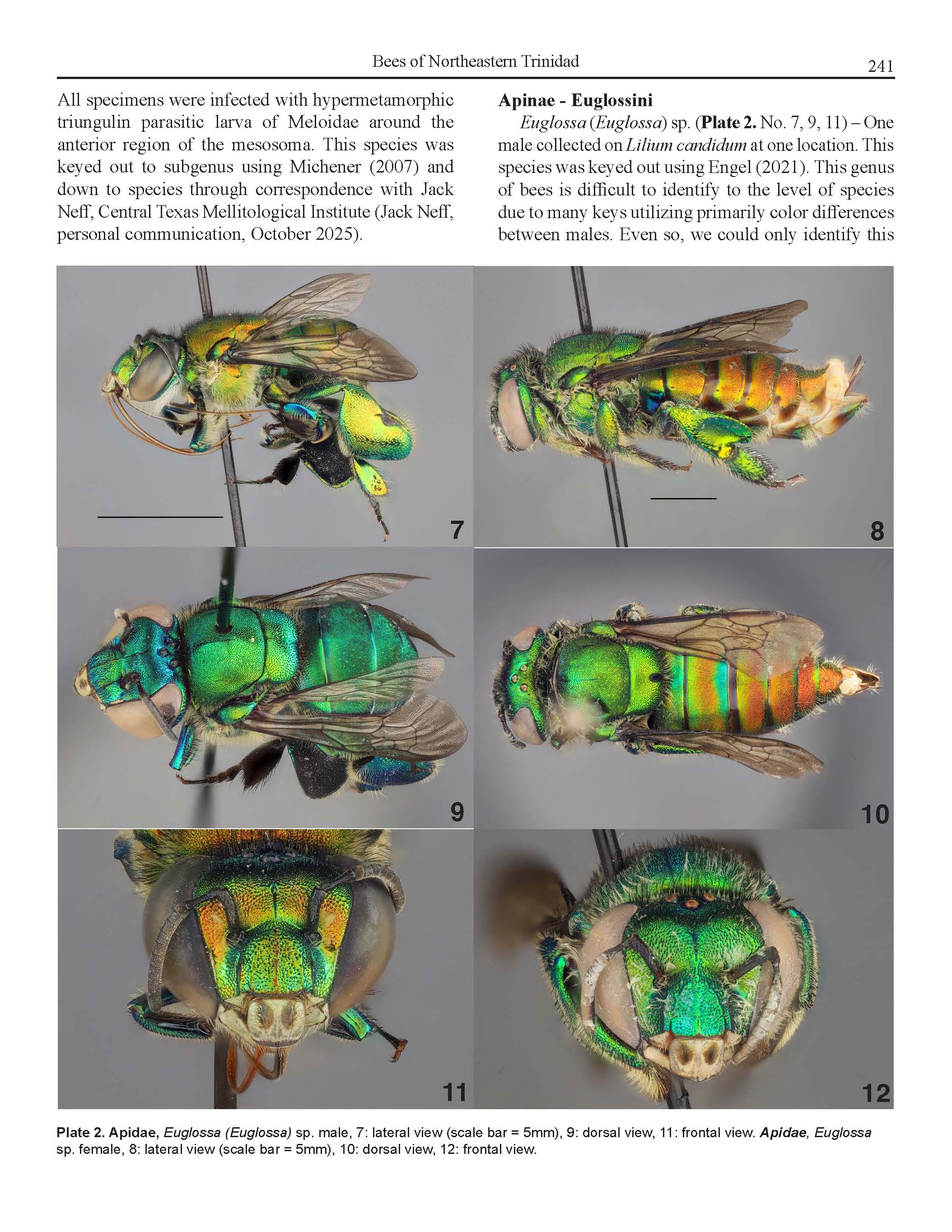
This study surveyed bees (Hymenoptera: Apoidea) in the Toco region of northeastern Trinidad. Twelve locations were sampled around the region over the span of 11 active collection days, from May 27 to June 4 and June 9 to June 10, 2023. Sampling habitats included secondary forest, primary rainforest, semi-active woody agricultural areas, and a riparian corridor. Yellow, blue, red, and white pan traps, a Malaise trap, aspirators and sweep nets were used to survey the area. Identification of all species to genus, subgenus or species were conducted at Texas A&M University using standard taxonomic references. Three photos of an individual of each species were taken (lateral, dorsal, and frontal) using focus-stacking software to provide a visual guide to the bee fauna in the area. When species were collected while foraging on a plant, the host plant was identified. A total of 78 specimens representing 17 different species in 13 different genera were collected and identified. It was also observed that hypermetamorphic triungulin coleopterans infested several Epicharis bees.